Overflowing garbage. Backed-up sinks. Food prepped in bushes. More than 800 pounds of food tossed due to improper temperatures.
These are just a few examples of food safety problems city inspectors documented during one hot weekend in July when one of the city’s largest culinary events, Taste of Chicago, took place in Grant Park.
The food festival kicked off as the country was still grappling with a Cyclospora outbreak that disrupted food systems and left consumers guessing what's safe to eat, all amid a rollback of federal regulations.
Chicago is a festival-friendly city, and after another jam-packed summer event season, WBEZ/Sun-Times wanted to know how Chicago inspects food at major outdoor events. We also wanted to know which events city sanitarians inspect — and found little evidence that some private events, like Lollapalooza, are inspected at all.
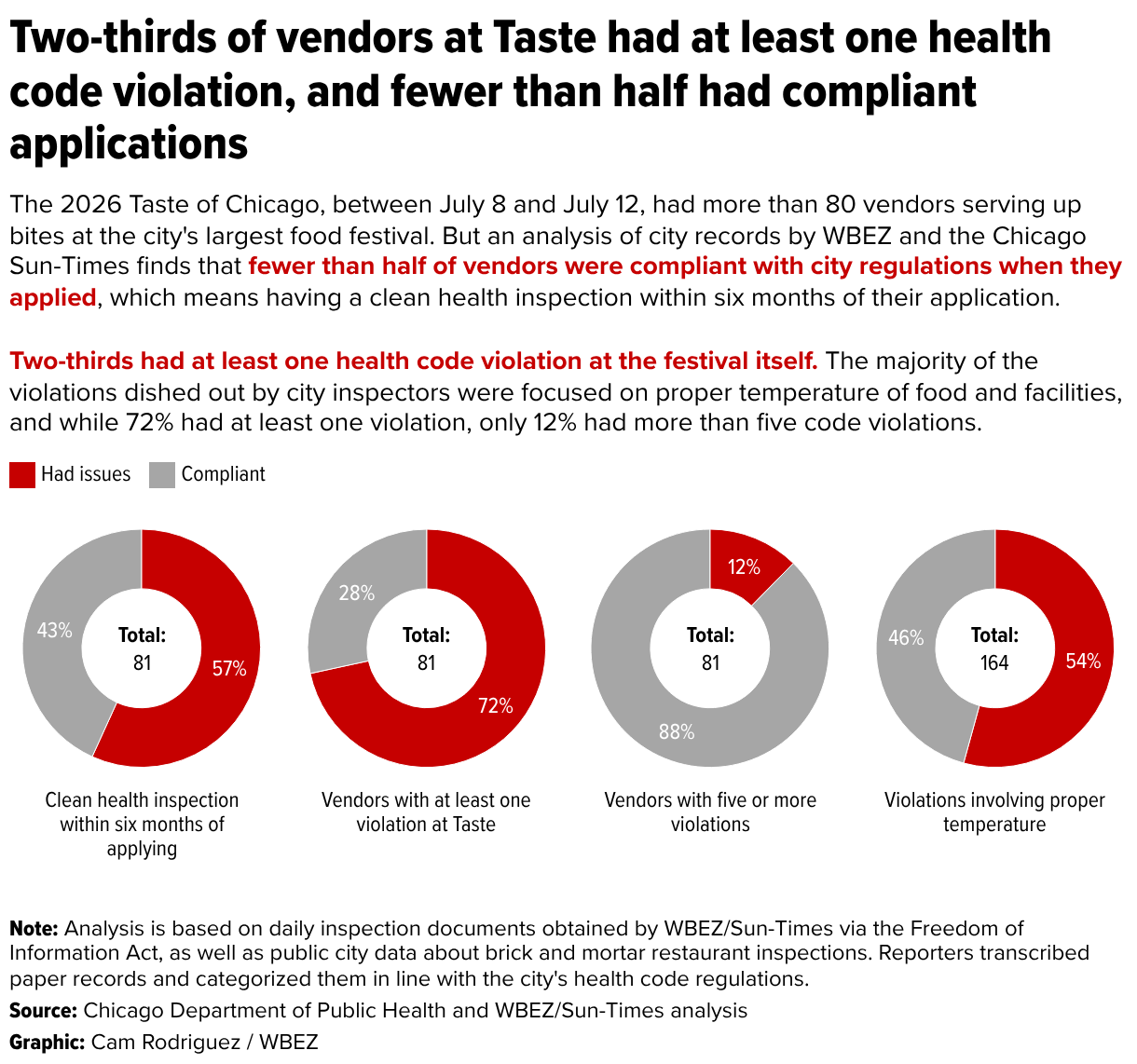
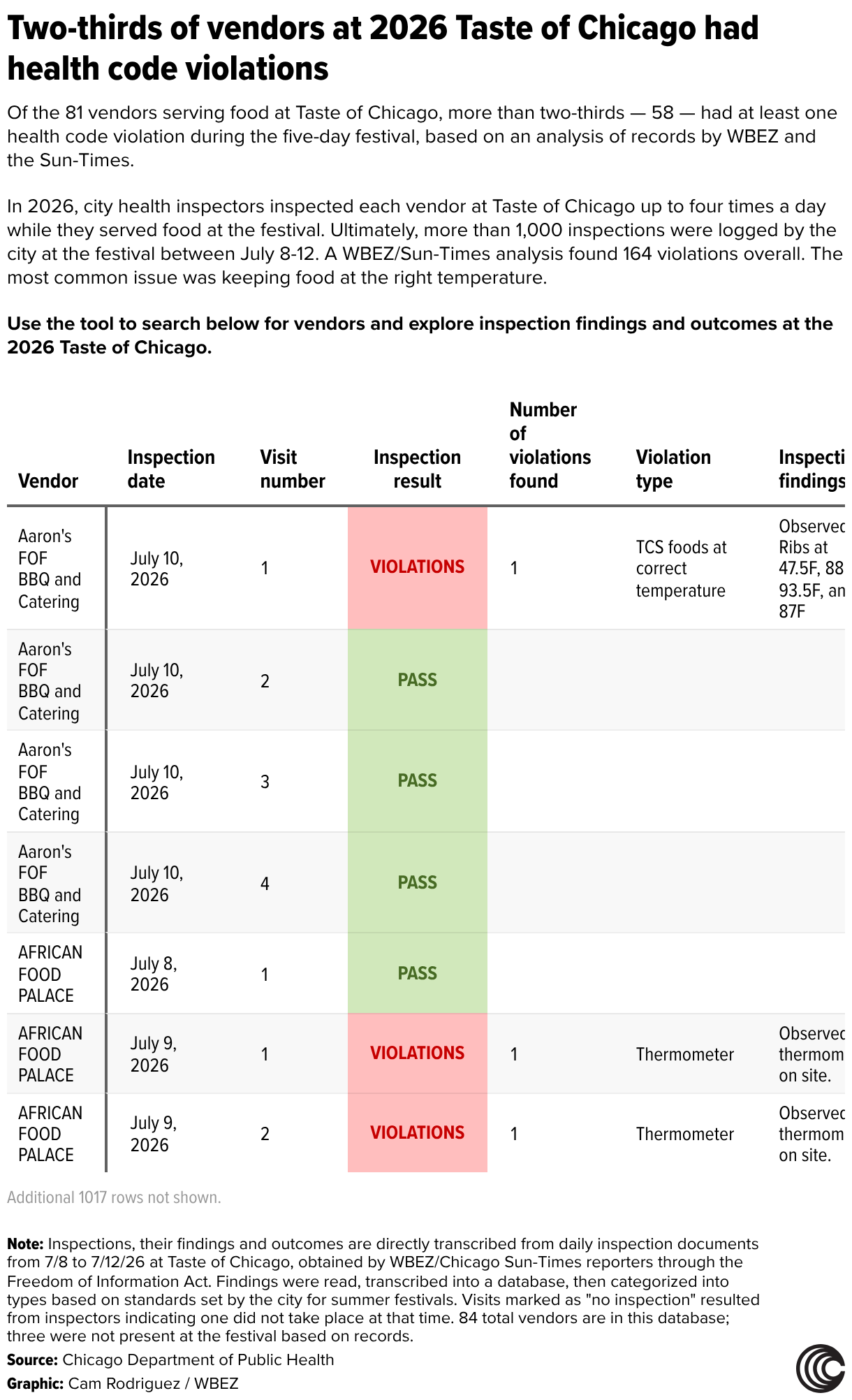
At Taste of Chicago this year, 81 vendors served up regional and international dishes to thousands of people across five days. According to records obtained by WBEZ/Sun-Times from the Chicago Department of Public Health and the Department of Cultural Affairs and Special Events, inspectors logged more than 160 health code violations during the festival. More than half of vendors listed received violations, our analysis shows.
Some on-site infractions were minor, like slow-draining sinks, employees in tank tops and missing food safety licenses. Others were far more troubling, like food being prepared in bushes and stored at unsafe temperatures in the summer heat.
The records also revealed a potential lack of oversight in the city’s application process. Local food vendors go through a lengthy approval process to participate in Taste of Chicago that includes submitting business certifications and a clean health inspection of a brick-and-mortar site or food truck within six months of the festival application date, according to the Chicago Department of Public Health and the Department of Cultural Affairs and Special Events.
But according to a WBEZ/Sun-Times analysis of records, including Taste application materials and restaurant inspections, fewer than half of the 81 vendors met those requirements.
All vendors serving food at Taste ultimately had a “pass” on file with the health department before the event, although many of those passed inspections were outdated and outside of the application’s required six-month window. According to records analyzed by WBEZ/Sun-Times, others only had a conditional pass on file. (Inspectors pass a restaurant with conditions when it has some violations but not enough to be an immediate hazard for food safety.)
What’s more, nine restaurants failed inspections at their brick-and-mortar locations in the months between applying and the festival start date.
One example is Ponce Restaurant, at 4313 W. Fullerton Ave., which submitted an application on April 21, then failed an inspection on June 24 — just two weeks before Taste. One of the city’s health inspectors noted “evidence of rodent activity on the premises,” citing approximately 35 mouse droppings throughout the rear storage area and behind chest freezers and storage racks at the brick-and-mortar location. Inspectors also reported opened food packages stored without proper labels.
When Ponce was re-inspected on July 2, a week before the Taste festival, city inspectors passed the restaurant. The report doesn't indicate any issues regarding pests or pest control but didn’t note how the rodent droppings were addressed.
But at the Taste, records show inspectors failed Ponce for three out of the vendor’s four inspections conducted on the first day, including for holding food at improper temperatures. A few days later at the festival, the same issue prompted the restaurant to discard at least 95 pounds of pork, plantains, lettuce and tomatoes. Ponce Restaurant didn’t reply to several requests for comment.
It wasn’t just booths that had issues leading up to — or at — Taste. Food truck Yummy Halal failed a June 16 inspection, just 22 days before Taste, when a city inspector observed “approximately 40 or more rat droppings” on the floor of the business’ food truck, plus wastewater streaming from the exterior water tank onto a city street, according to a report.
Then, while at Taste, the food truck failed five health inspections, with violations including improper holding temperatures of ingredients and a lack of hair restraints. The food truck was later shut down for the day by city inspectors for failing to have a certified manager on-site. Yummy Hall didn’t respond to requests for comment either.
While the Chicago Department of Public Health didn’t indicate any signs of foodborne illness as a result of 2026’s Taste, in 2007, the department inspected a Salmonella outbreak after the event as a result of a hummus dish from vendor Pars Cove Persian Cuisine. The outbreak sickened more than 300 people.
Researchers have found that issues with temperature control tend to be the leading contributors to foodborne illness outbreaks involving bacteria such as Salmonella, E. coli, Listeria and Staph. And the foot traffic Taste can receive, combined with the hot temps, can mean that improperly stored food can put people at risk.
WBEZ/Chicago Sun-Times analyzed thousands of pages of records from the 2026 Taste of Chicago obtained from city agencies via the Freedom of Information Act. We built a database of each vendor and their health inspection data, both at the festival and at the restaurants’ year-round brick and mortar locations. We found:
The latter list included Josephine’s Southern Cooking, which applied with an outdated health inspection. The restaurant ultimately passed an inspection between its application and the festival itself. But at Taste, it was cited for washing dishes and preparing food on site — two actions that are not allowed. On the last day of the festival, inspectors failed the booth for filling shrimp dumplings on a folding table behind their tent along hedges in the park.
Oooh Wee Smothered, a spin-off of Chatham staple Oooh We! It Is!, had a clean health inspection just a month and a half before they applied to Taste, fully in compliance with the city’s requirements.
But at the festival itself, the restaurant racked up nine different violations across two days. That included failing their first inspection for not having someone on site with a certificate, holding food at improper temperatures and storing cooked chicken in a container that previously contained raw chicken.
The certificate holder came back on site, and the food was discarded. But a few days later, Oooh Wee was cited for prepping food on site, a mayo-based sauce testing overly warm and a too-hot cooler.
Asked about the Taste of Chicago inspection report, Richard Little, manager of the Chatham Oooh We! It Is!, said DCASE provides vendors with a trailer for vendors to store cold items. The trailers are shared by at least seven to 10 different businesses, he said, and on day one, the trailer was malfunctioning, through no fault of the restaurant’s own, Little said. “We never even got compensated for it,” Little said. He said he’d been in contact with someone from DCASE about receiving a dollar amount reimbursement for the malfunctioning trailer, but nobody from the department ever followed up with the restaurant, he said.
On day four of the festival, an inspector cited Oooh Wee for chopping green tomatoes on-site. Little told a reporter he received mixed messages about food preparation from the inspectors: One of them told him the tomatoes were fine to be chopped at the tent, while a second inspector hours later told them it was not allowed. “We like the Taste of Chicago, we appreciate the opportunity to be a part of it,” Little said. “Could things have been run a little bit smoother in regards to the inspection process and the malfunctioning of the refrigeration unit? I think they could have dealt with that a little better.”
Little said businesses like Oooh Wee spend so much time, resources and money to participate in events like the Taste of Chicago. “The general public and customers are most important. If [inspectors] say something needs to be thrown out ... we don't want to take any chances," he said.
Asked about malfunctioning trailers, DCASE said it contracted with an external company to provide the trailers, and there were no reports of them malfunctioning.
An analysis of records by WBEZ/Sun-Times reporters show the most common issue flagged by vendors at Taste was improper hot and cold holding temperatures for foods.
Inspectors, for example, discovered pre-cooked chicken held at improper temperatures at a Harold’s Chicken food truck on the first day of the festival, leading to employees discarding about 210 pounds of food.
At least 40 other vendors were cited for the issue by city inspectors, which led to at least 800 pounds of food being discarded throughout the festival.
“Through CDPH, the City continues to prioritize strengthening food safety inspections, enforcement, and compliance efforts,” read a statement from a mayor’s office spokesperson. That includes multi-agency collaboration, preventative public messaging and staying “in touch with individuals testing positive for infections such as Cyclospora, tracing their food history to identify potential clusters,” the statement read.
Chicago street and neighborhood fests are usually brimming with food vendors, but according to a list of events inspected by CDPH and obtained by WBEZ/Sun-Times reporters, not all festivals are inspected every year. For example, Windy City Margarita Fest, which takes place in Pilsen each summer, was inspected this year but not in 2025.
City-sponsored events inspected by the department in 2026 include RibFest Chicago, Square Roots Festival and Market Days.“We prioritize events with higher numbers of vendors, so a lot of the street fests,” said Jacob Martin, the information coordinator for CDPH.
He said CDPH’s sanitarians do not inspect private events like Lollapalooza and Riot Fest even though they take place on public property. Lollapalooza attracts more than 100,000 festivalgoers daily across four days in Grant Park at the end of July, while Riot Fest brings an estimated 50,000 people a day to Douglass Park in September.
According to Martin, it is the job of CDPH to inspect a festival, but the department does not review or approve licenses or event requests. Public health sanitarians perform inspections at the request of a different city department, Business Affairs and Consumer Protection or BACP, which takes applications and approves license applications for events, such as the Taste of Chicago.
“Essentially, the BACP processes the applications, and they tell us where to go, and we send inspectors there, and then we send the inspection report to BACP,” Martin said.
Initially, when asked about health inspection requirements for events like Lollapalooza, DCASE, which permits festivals and special events in Chicago, referred WBEZ/Sun-Times to the Chicago Park District. The Chicago Park District, which does oversee year-round concessions in Grant Park, referred reporters to the Chicago Department of Public Health. And the health department, in turn, pointed toward event organizers.
“Lollapalooza is a privately organized, short-term event held on Chicago Park District property. Event organizers are responsible for ensuring participating food vendors have the appropriate licenses and/or permits and operate in accordance with applicable food safety requirements,” a spokesperson from DCASE wrote in an email to WBEZ and the Sun-Times, adding that “CDPH does not conduct on-site inspections at privately organized events held on Chicago Park District property.”
C3 Presents, the event management company that puts on Lollapalooza each year in Grant Park, did not respond to multiple requests for comment.